tray history invention
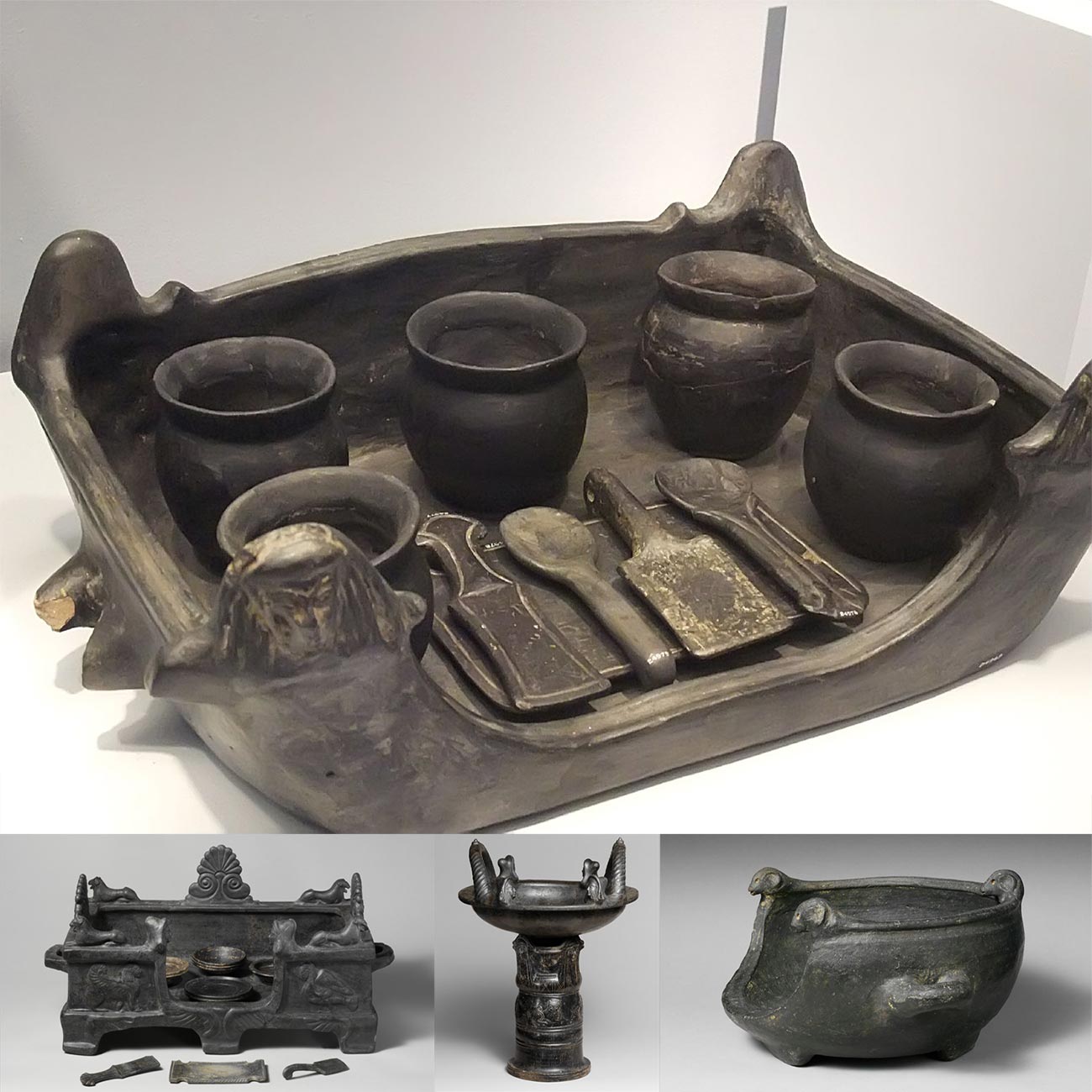
The first tray made in the world was invented in the 7th century BC by the Etruscan civilization in Italy. These trays were made of pottery and were only found in the homes of the wealthy and aristocratic Italians, who also made pottery trays alongside their ancient statues.
In ancient Egypt, the tray was a symbol of luxury, and the Pharaoh’s serving trays were made of gold and marble.
During the reign of Queen Victoria in Britain, during the height of the Industrial Revolution, trays were made of silver, and even in the 18th century, the tray was a symbol of wealth and luxury, and ordinary people did not have it.
Trays of the Etruscan civilization of the 7th century BC

The use of a spirit tray or aluminum tray has been common since ancient times.
The tray was used in England in the mid-17th century. Usually, the trays were without handles and made of silver.
These trays were used by royal families, and serving food on these trays indicated that it had been tested by a waiter and was free of poison.
During the 18th century, the trays changed and became round and oval in shape and were raised all around with a casting mold.
This protrusion was used as a handle on the trays. Since that time, trays have also been used in Iran. Large trays with a diameter of more than 30 centimeters are called maghme.
In the past, maghme were made of copper, but today aluminum and steel alloys are more often used.
Clay trays from the Etruscan civilization in modern-day Italy

The first tray made in the world dates back to the 6th or 7th century BC and was made of pottery.
Research into the history of tray making shows that these trays were used in the homes of the nobility and the wealthy and were not available to everyone.
The trays that we use today for various tasks and serving have changed over time.
Since the mid-17th century, silver has been used in England to make trays, which are beautiful and durable, but gradually over time, trays have been made of different materials and in various shapes.
It is interesting to know that in the 18th century, the oval tray became popular, which had strong handles made of the tray itself so that it could bear more weight and was used to serve tea and coffee to family members or guests.
In the early 19th century, long and elongated trays replaced oval trays and it became fashionable to use these trays among people.
These trays had a high edge to protect the items inside and prevent them from slipping and falling.
Egyptian Pharaoh’s Gold Trays

History of Copper Trays
The use in human history dates back several thousand years.
Archaeological remains show that copper was widely used in ancient times, especially in the Mesopotamian and Egyptian civilizations.
Copper trays were known as a symbol of wealth and power during these periods.
Copper Trays in Iran
In Iran, copper trays have a rich and long history.
From the Achaemenid to the Sasanian periods, copper trays were used as an important element of dining and parties.
These trays were considered not only for serving food but also as decorative elements.
During the Safavid era, copper trays reached the peak of their beauty and art, and artists designed and produced them with great care and elegance.
The art of painting and design on copper trays
One of the prominent features of copper trays is their art of painting and design.
By combining floral and plant motifs, calligraphy, and religious images, Iranian artists have created beautiful trays, each with a story to tell.
This art not only adds to the beauty of the trays but also gives them a deeper meaning.
Copper trays have many properties
As a natural metal, copper has unique properties.
This metal is very suitable for storing food and drinks due to its antibacterial properties.
Copper also conducts heat well, which allows foods to be served at the right temperature. These properties make copper trays a healthy and practical choice.
Tajik Qajar Tray
Tajik trays, especially during the Qajar period, were usually made of copper, brass or silver and decorated with the art of engraving with designs of birds, flowers and plants and geometric patterns.
These dishes were not only used in reception ceremonies, but were also known as ornamental objects and symbols of splendor and art in noble Iranian and Tajik homes.
Engraving on metal in Tajikistan and Iran is one of the important artistic features that has its roots in past centuries and still has a very high historical and artistic value today.
Queen Victoria’s silver trays in the 18th century

Tray is a flat, shallow container made of wood, metal, or a combination of both, used to carry food and drink.
Trays have been used since ancient times. The pedestal tray is an evolution of the tray that was used in England from the mid-17th century, and was handleless and usually made of silver.
These trays were used by royal families. Placing food on these trays indicated that the food had been tested by a waiter and was free of poison.
During the 18th century, trays were generally oval in shape and had a raised rim around it. This raised rim was also used as a handle.
It was during the 19th century that handles were added to larger trays to make it easier to carry drinks.
Trays in Western Cultures
In Western countries, trays are very common, especially at formal events and weddings.
Silver and steel trays are considered a luxurious element in catering.
In these cultures, the use of trays for serving food is done in a traditional way, according to its specific structure and order.
Buying steel trays for gatherings and parties can help make the reception space more beautiful.
Old Shirazi Tray
Old Shirazi trays are among the valuable handicrafts of Iran from the Safavid to Qajar periods.
Shiraz, due to its artistic background and the presence of skilled craftsmen in the field of metalwork, had a special place in the manufacture of old utensils such as copper and silver.
During the Qajar era, making trays was not only a consumer aspect but also a symbol of social and artistic status.
Most of these trays were made with engraving and casting techniques, and having the master’s seal on them was a proof of the authenticity and quality of the work.
Large and heavy trays were usually used in important ceremonies, court receptions, or aristocratic dowries.
Today, such works are considered collectible and ornamental items due to their historical and artistic value.
History and Uses of Cardboard Bread Trays
Personalization The use of cardboard bread trays for food dates back to the days of ancient China.
Where it was customary to present dishes in beautiful paper dishes at happy celebrations and wonderful events.
This ancient technique has great social value, as the paper boat represents success and good fortune and symbolizes hope and aspiration for those attending the celebration.
Over time, the charming custom of serving food in paper boats traveled throughout Asia, eventually making its way to remote lands where it effortlessly became incorporated into countless culinary styles.
True Integration into Culinary Traditions
In the refined world of Japanese cuisine, cardboard serving trays are often used to display delicious sushi and sashimi, enhancing the visual appeal of the recipes.
Meanwhile, in coastal India, the use of boat-shaped serving trays to serve fish and shellfish demonstrates the deep-rooted connection between the culture and the bountiful sea.
Similarly, in the sun-drenched lands of the Mediterranean, paper serving trays are used to present fried fish and shellfish, providing a unique and memorable experience for restaurants.
Since ancient times, the deposits of copper, tin and other metals in the territory of Sedna have contributed to the development of metal production.
Mining reached its peak in the 9th-12th centuries AD. This also influenced the development of metalworking art in the 11th century AD.
The influence of Islamic and Arab art was already noticeably felt on the territory of modern Tajikistan.
The traditional combination of precise geometric shapes and ornamental floral patterns is embodied in the bronze tray.
The decorated tray dates back to the 11th century and was found in Tajikistan.
Another 59 pieces are on display, collected by national museums of countries along the Silk Road for an exhibition created by UNESCO.
Flat trays were originally known as silver trays in mid-17th century England and were usually made of silver and were mostly owned by wealthy families.
The use of silver trays indicated that food or drinks were intended for royalty and had passed the poison test.
The first confirmed example of any type of tray dates back to the 7th or 6th century BC, namely the black clay tray of Etruscan Italy, which was made of clay like ancient statues.
However, there is no certainty that this is the oldest tray in existence.
But it certainly shows that the concept of a serving tray is quite ancient and that these serving plates were present in aristocratic homes long before they became common.
Flat trays were originally known as salvers in mid-17th century England and were usually made of silver and were mostly owned by wealthy families.
The use of a salver indicated that the food or drink was intended for the royal family and had passed a poison test.
This serving utensil indicated that the testing process had been completed and the food was safe for the king and queen to eat.
The history of English, Scottish and Irish salver trays dates back to the 17th century.
In the 18th century, these trays became popular in an oval shape with ring handles.
By the 19th century, the popularity of cafes and restaurants made them a part of people’s daily lives and salvers soon became an essential appliance in the home.
During this time, tall, rectangular trays became quite fashionable.
The Evolution of Serving Trays
The original design of serving trays was flat, but to make them more practical, raised edges were created around the surface of these essential home decor items to prevent items from slipping on them.
Today, trays are available in a wide range of materials such as marble, stone, wood, crystal, from leaf designs to animal shapes.
Their designs are used not only for serving but also in the medical world in the form of surgical trays
Qajar Iranian copper tray

What was the first tray for and where was the tray invented? Serving trays were first used in ancient Egypt, where they were a symbol of luxury and were made from materials such as gold and marble.
History of Serving Trays Through Time
The first serving trays date back to ancient civilizations, where they symbolized luxury and practicality.
Egyptian Elegance:
In ancient Egypt, serving trays were made from materials such as gold and marble. These luxurious trays, adorned with hieroglyphs and intricate designs, were used during great feasts and religious ceremonies to convey wealth and respect.
Roman and Greek Banquets:
The Romans and Greeks used serving trays extensively during public gatherings and banquets. The Romans preferred silver and bronze trays for their durability and elegance, while the Greeks incorporated artistic elements often inspired by nature.
Serving Trays in Asian Traditions:
The rich history of Asia has had a significant impact on the development of serving trays.
Chinese Lacquered Trays:
In Chinese dynasties such as the Tang and Ming, trays made of lacquered wood and gold inlays were considered luxurious. They were prominently used in tea ceremonies and to serve delicacies at royal banquets.
Indian Brass and Copper Trays:
Indian artisans made brass and copper trays that were intricately carved with mythological motifs. These trays played a central role in religious rituals and royal courts.
Medieval Serving Trays
European Nobility
In medieval Europe, metal trays, often engraved with family crests, became status symbols among the nobility. Made of tin or silver, these trays displayed the wealth and social standing of the family.
Islamic Art
Islamic culture brought artistic sophistication to serving trays, emphasizing geometric and floral patterns. These designs reflected the culture’s interest in symmetry and were used for feasts and celebrations.
Renaissance Developments
Ornate Serving Trays
The Renaissance period brought an artistic revolution in serving trays. Designs became more intricate, reflecting the era’s obsession with detail and splendor.
A Symbol of Status
Having a serving tray made of gold or silver during this period was a sign of wealth and sophistication, making it a prized possession in aristocratic households.
The Victorian Era and Beyond
Silver Trays in Victorian Society
The Victorian era popularized silver trays as a symbol of elegance. These trays were decorated with intricate floral patterns and were widely used at afternoon tea parties, showcasing elegance and class.
Wooden and Porcelain Trays
This period also saw the emergence of porcelain trays with delicate hand-painted designs. Wooden trays became a more affordable option, suitable for the growing middle class.
The Modern Age and Industrial Influence
Mass Production
With the advent of industrialization, serving trays became more accessible to the general public. The shift from handmade designs to mass production made them an everyday household item.
20th Century Design Trends
Modern designs focused on minimalism and functionalism. While some favored clean, sleek styles, others embraced bold, decorative patterns. The mid-20th century saw a mix of these aesthetics that reflected societal changes.
Eco-Friendly Designs
In response to environmental concerns, materials such as bamboo and recycled wood have become popular, promoting sustainability.
Why were silver trays popular during the Victorian era? Silver trays became a sign of sophistication, used at afternoon teas to display elegance.
What are modern serving trays made of? Contemporary serving trays use materials like bamboo, acrylic, stainless steel, and recycled wood, and focus on aesthetics and sustainability.
How have serving trays evolved over time? Serving trays have evolved from ornamental symbols of wealth to functional and stylish home essentials that reflect cultural and technological advancements.